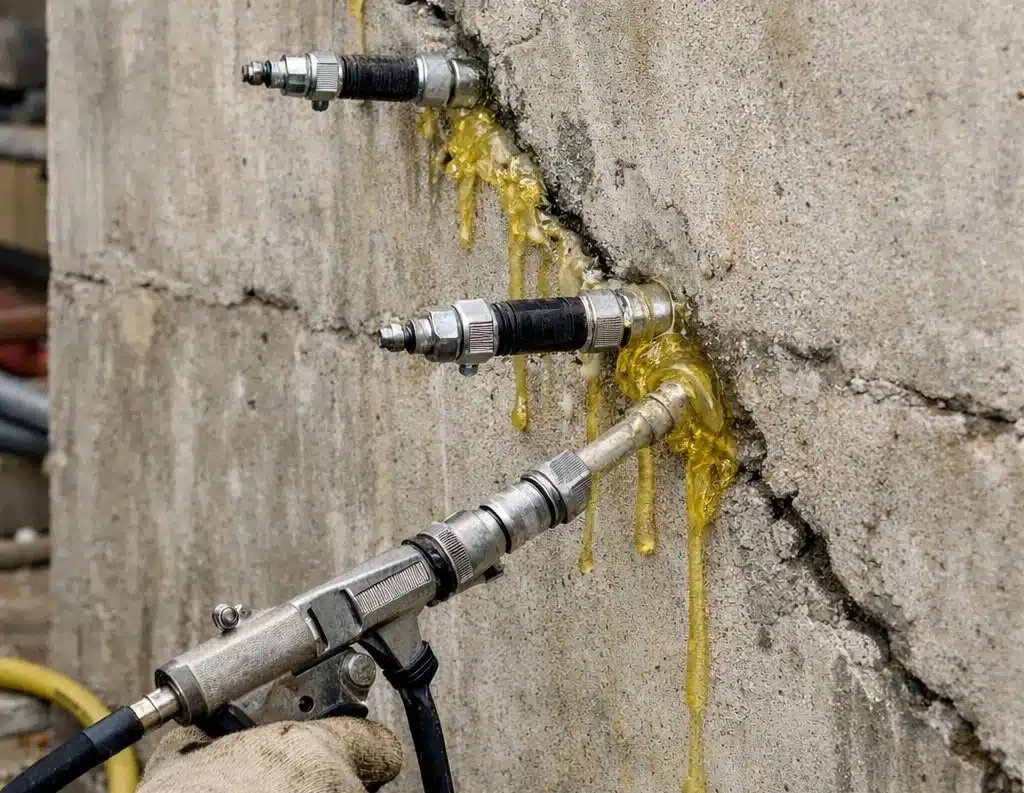
Injection Grouting
Why PU Injection Grouting Fails to Stop Water Leakage
Understand why water leakage can continue after PU injection grouting and what should be assessed before reinjection.

PU injection grouting is commonly used to stop water entering through concrete cracks, joints and underground voids. However, completing an injection does not necessarily mean that the entire leakage path has been sealed.
Water may continue to appear, move to a nearby location or return after an initial improvement. This does not always mean the resin itself has failed. The cause may involve leakage diagnosis, material selection, packer positioning or the way the resin was delivered.
Here are six common reasons PU injection grouting may not achieve the intended result.
1. Only the Visible Leak Was Treated
The location where water emerges is not always its original entry point.
Groundwater can travel behind a tunnel lining, through connected cracks or along construction joints before reaching the visible surface. Injecting directly beside the wet area may stop one outlet without filling the main water path.
This can cause the leakage to reappear through another crack or joint nearby. Assessment should therefore consider the wider leakage pattern, not only its most visible point.
2. The Wrong PU Resin Was Selected
PU injection resins differ in viscosity, reaction time, expansion and flexibility.
A fast-foaming resin may be useful for controlling substantial water flow, but its rapid reaction can limit penetration into fine or deeper cracks. A slower, lower-viscosity resin may travel further but can be displaced where water flow is strong.
The selected product must match:
Water activity and pressure
Crack or void dimensions
Required penetration
Expected joint movement
Wet or dry substrate conditions
Intended properties after curing
There is no single PU resin suitable for every underground leak.
3. Injection Points Did Not Reach the Leakage Path
The position, angle and depth of the drilled holes affect whether the injected resin reaches the crack or joint.
If a hole misses the leakage path, the material may remain around the packer or enter an unrelated void. Packers positioned too far apart can also leave untreated sections between injection points.
Where several cracks or joints are connected, the injection layout may need to address more than one route.
4. Reaction Time Was Unsuitable
Reaction time influences how far the resin can travel before it foams or cures.
If the reaction is too fast, the material may expand close to the injection point without reaching the deeper leakage path. If it is too slow, moving water may carry the resin away from the intended area.
Temperature, moisture and catalyst dosage—where an approved catalyst is used—can all influence reaction behaviour. Adjustments must remain within the manufacturer’s technical requirements.
5. Injection Delivery Was Not Properly Controlled
More pressure does not automatically produce better penetration.
Excessive or uncontrolled injection pressure can force resin into unintended voids, cause surface breakout or potentially affect weak surrounding material. Insufficient pressure may prevent the resin from reaching the required depth.
The pump, hoses, packers and resin must also be compatible. Blocked components, leaking connections or inconsistent mixing can interrupt material delivery and reduce the effectiveness of the injection.
6. Movement or Hidden Voids Were Not Considered
A crack or joint may reopen if it continues to move after being filled with an unsuitable material.
Hidden voids behind a lining can also require more resin than initially expected. If only part of the void is filled, groundwater may continue travelling around the cured material.
Monitoring material consumption and checking whether resin reaches adjacent packers can help indicate how it is moving within the structure.
What Should Be Checked Before Reinjection?
Repeatedly injecting the same point without reassessing the leakage can waste material and redirect the water elsewhere.
Before reinjection, the site team should review:
The current location and pattern of leakage
Whether the water has shifted since the first treatment
The original drilling and packer arrangement
Resin type and reaction behaviour
Material consumption during the first injection
Water pressure and site conditions
Possible movement or concealed voids
Whether a different resin or injection sequence is required
Successful injection grouting depends on coordinating the leakage assessment, resin, pump, packers and application approach.
OSE supplies PU injection resins, injection pumps, packers and accessories for underground leakage-control applications. We also support injection works involving tunnels, shafts, pipe-jacking operations, sheet piles and ERSS walls.
Contact OSE to discuss a persistent underground leak, reinjection requirement or the selection of compatible injection materials and equipment.
This topic is technically supported by industry guidance identifying chemical injection as a common method for tunnel crack and joint leakage, while differentiating resin behaviour according to water reaction and cured properties. National Academies tunnel-leak guidance OSE’s current services and products also align directly with this problem-aware search intent. OSE services and OSE products.
Insights & Article