PU Chemical Resin
Choosing the Right Injection Resin for Underground Waterproofing
Understand how leakage activity, water conditions, crack movement and application requirements influence injection-resin selection for underground waterproofing.

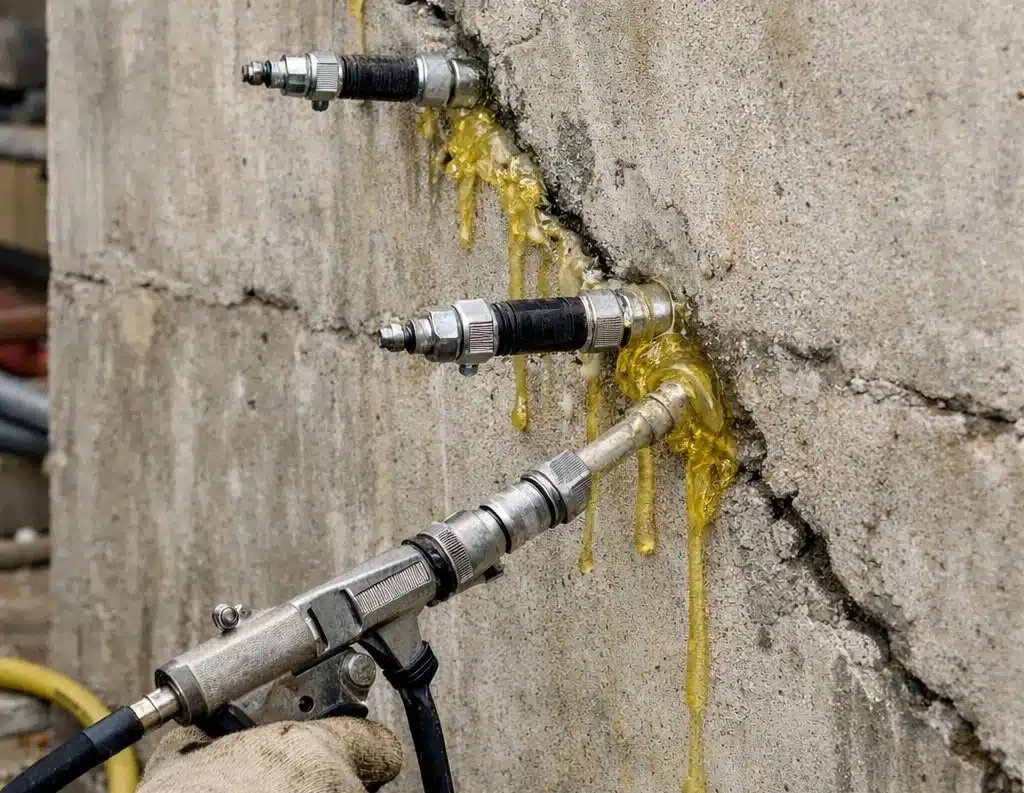
Certain PU resins react when they encounter water and form a foam that expands into cracks and voids. This can help control active water flow and create the conditions required for further treatment.
Other PU formulations cure into a denser or more flexible material intended to form a longer-term seal. Depending on the product, they may be used for cracks, joints and areas where limited movement is expected.
PU injection resin may be considered for:
Active water-bearing cracks
Construction-joint leakage
Tunnel segment joints
Leakage around service penetrations
Voids behind concrete linings
Pipe-jacking and shaft leakage
Sheet-pile or retaining-wall water ingress
PU products should not be treated as interchangeable. Their reaction behaviour, expansion, viscosity and cured properties can differ substantially.
Epoxy Injection Resin
Epoxy injection resins are generally used where bonding and the rigid filling of cracks are required.
Low-viscosity epoxy can penetrate fine cracks under suitable conditions and cure into a hard material with strong adhesion to concrete. It is commonly associated with the repair of stable cracks where structural continuity or strength restoration is part of the objective.
Epoxy is generally less suitable as the first response to actively flowing water unless the particular product has been formulated and approved for wet or underwater conditions.
Epoxy injection may be considered where:
The crack is stable and not expected to move
Structural bonding is required
The leakage has already been controlled
The substrate condition is compatible with the product
A rigid rather than flexible repair is appropriate
Some specialist epoxy products are designed for damp or underwater applications. Their suitability must be confirmed from the individual product’s technical documentation rather than assumed from the term “epoxy”.
Key Factors in Injection-Resin Selection
1. Active or Dormant Leakage
An actively flowing leak requires a material capable of reacting and remaining effective in the presence of water.
Fast-reacting PU foam may be used to control flowing water. However, rapid foaming alone does not automatically produce a complete long-term seal. Depending on the condition and specified repair system, a secondary injection using a flexible, non-foaming or lower-expansion resin may be required.
For dormant or previously dried cracks, other resin types may offer better penetration or bonding characteristics.
2. Water Flow and Pressure
A minor damp patch and a pressurised underground leak present very different injection conditions.
Higher water flow may wash unsuitable material away before it reacts or carry it beyond the intended treatment area. A faster-reacting resin may help control the initial flow, while a slower material may provide better penetration when water movement is limited.
Selection should balance reaction time with the amount of penetration needed. The fastest product is not necessarily the most suitable product.
3. Crack, Joint or Void Size
Viscosity affects how easily a resin enters a leakage path.
A low-viscosity resin can generally penetrate finer cracks and narrow interfaces more effectively. A material with greater body or expansion may be more suitable for larger voids or locations where rapid water cut-off is required.
Very low viscosity can also allow resin to escape into unintended areas if the leakage path has not been properly assessed. The injection layout and material consumption must therefore be monitored during application.
4. Expected Movement
Underground structures may experience movement caused by loading, temperature changes, settlement or joint behaviour.
Rigid epoxy may be suitable for a stable concrete crack but can be inappropriate where continued movement is expected. Flexible PU resin may be better suited to selected moving cracks or joints, provided its movement capability matches the application.
Material flexibility should be assessed after curing, not assumed from its liquid state during injection.
5. Wet, Damp or Dry Substrate
Some resins require water to initiate their reaction, while others perform best when the crack is dry or has only limited moisture.
The presence of groundwater may affect:
Reaction speed
Adhesion
Expansion
Penetration
Final cured properties
Long-term dimensional stability
The actual moisture condition must be compared with the manufacturer’s stated application requirements.
6. Reaction Time
Reaction time determines how long the resin remains injectable before it begins to expand or cure.
A fast reaction can be useful for controlling substantial water flow, but it may restrict how far the resin penetrates. A slower reaction provides more travel time but may allow the material to be displaced by moving water.
Some resin systems allow their reaction time to be adjusted using an approved catalyst. Any adjustment must remain within the manufacturer’s specified limits.
7. Expansion and Foaming Behaviour
High expansion can help a resin fill larger voids and temporarily control active leakage. However, foam volume alone does not determine the quality or durability of the repair.
The density and stability of the cured material are also important. A highly expanded foam may contain a more open cellular structure than a dense, low-expansion material.
Selection should therefore consider whether the purpose is immediate water cut-off, permanent sealing, void filling or a combination of these objectives.
8. Hydrophilic and Hydrophobic Behaviour
PU injection resins may be described as hydrophilic or hydrophobic.
Hydrophilic resins interact readily with water and may be useful where moisture is consistently present. Depending on their formulation, some may absorb water after curing and remain flexible.
Hydrophobic resins require limited water to initiate their reaction but form a cured material that resists water absorption. They are commonly used for water cut-off and void-filling applications.
These classifications describe general behaviour only. Long-term performance varies by formulation, so selection should be based on the individual product data rather than the category name alone.
9. Injection Equipment and Application Method
The chosen resin must be compatible with the available pump, hoses, packers and cleaning procedure.
One-component and two-component resins require different equipment arrangements. Highly reactive two-component materials may require pumps that keep the components separate until they reach the mixing head.
Equipment should allow the applicator to control:
Material delivery
Injection pressure
Mixing ratio where applicable
Flow rate
Reaction timing
Cleaning and flushing
Incorrect equipment can result in poor mixing, premature curing, blocked hoses or inconsistent injection.
10. Service and Environmental Requirements
The treated area’s future exposure should also be considered.
Relevant conditions may include:
Continuous groundwater contact
Chemical exposure
Potable-water requirements
Temperature
Repeated wetting and drying
Joint movement
Required design life
Project-specific environmental or safety restrictions
Any required approvals or performance classifications must be verified using current product documentation.
Comparing General Resin Characteristics
Selection consideration | Water-reactive PU foam | Flexible PU resin | Epoxy injection resin |
|---|---|---|---|
Typical objective | Rapid control of active water and filling larger leakage paths | Sealing cracks or joints where flexibility may be needed | Rigid filling and bonding of stable cracks |
Water condition | Commonly used in water-bearing areas | Depends on the formulation | Commonly suited to dry or controlled conditions, unless specially formulated |
Expansion | Can range from moderate to high | Usually lower or non-foaming | Generally non-foaming |
Flexibility after curing | Varies by formulation | Designed to remain flexible | Generally rigid |
Fine-crack penetration | Depends on viscosity and reaction time | Can be suitable with the correct viscosity | Low-viscosity grades can penetrate fine, stable cracks |
Main limitation | Rapid reaction may restrict penetration; foam alone may not provide the intended permanent seal | Must be matched to water and movement conditions | Usually unsuitable for moving cracks or uncontrolled active leakage |
This comparison is general. Product-specific performance can differ, and the relevant technical data sheet takes precedence.
Why Resin Selection Cannot Be Based on Price Alone
The lowest-cost resin may become expensive if it does not reach the leakage path, reacts too slowly, cures too rigidly or requires repeated injection.
Material price should be considered together with:
Suitability for the defect
Required injection volume
Equipment and labour requirements
Application time
Need for secondary injection
Likelihood of reinjection
Long-term performance expectations
Site access and operational constraints
Selecting an appropriate material at the assessment stage can reduce unnecessary consumption and repeated remedial work.
Common Resin-Selection Mistakes
Injection work may fail or provide only temporary improvement when:
The visible leak is treated without tracing the water path
A foaming resin is assumed to be a complete solution for every leak
Reaction time is too fast for adequate penetration
Reaction time is too slow for the water flow
A rigid resin is used in a moving joint
Resin viscosity is unsuitable for the crack or void
Wet-surface compatibility is assumed without checking
The resin and pump are incompatible
Previous injection materials are not considered
Product limitations are ignored
The performance of injection grouting depends on the complete combination of diagnosis, material, equipment, packer arrangement and application control.
Selecting Resin for Underground Waterproofing
There is no single injection resin that is appropriate for every underground leakage condition.
A sound selection process should answer four main questions:
Where is the water travelling?
What must the injection achieve?
How must the material behave during injection?
What properties must it retain after curing?
Only after these questions have been considered should a particular resin and application approach be selected.
Injection Materials and Technical Support from OSE
OSE supplies PU injection resins, epoxy resins, injection pumps, packers and related accessories for underground waterproofing and leakage-control applications.
Our team supports contractors working with tunnel, shaft, pipe-jacking, deep-basement, sheet-pile and ERSS wall conditions. Product selection should be based on the actual site condition, project specification and the relevant manufacturer’s technical guidance.
Contact OSE to discuss injection-resin selection, injection equipment or an underground water-leakage application.
The distinctions above are consistent with manufacturers treating injection products as application-specific materials rather than interchangeable grouts. MC-Bauchemie’s tunnelling range covers subsoil injection, wide-area waterproofing, joint sealing and the remediation of cracks and voids, while OSE separately lists PU and epoxy resins within its product range. MC-Bauchemie tunnelling systems and OSE products.
Insights & Article