Tunnel Waterproofing
Common Causes of Tunnel Water Leakage During Construction
Understand the common causes of tunnel water leakage during construction and the factors that should be assessed before treatment.

Water leakage is a common challenge during tunnel construction because underground structures are continuously exposed to groundwater and surrounding soil pressure. Water may enter through cracks, joints, penetrations or defects in the waterproofing system.
The point where water becomes visible is not always its original entry point. Groundwater can travel behind tunnel linings or along connected joints before emerging elsewhere. Identifying the actual leakage path is therefore an important first step before any treatment is selected.
1. Cracks in the Concrete
Cracks may develop due to concrete shrinkage, temperature changes, loading, settlement or construction-related movement.
Even narrow cracks can create paths for groundwater, especially when the tunnel is exposed to sustained external water pressure. The appropriate treatment depends on whether the crack is active, stable, dry or carrying water.
2. Construction-Joint Defects
Construction joints are formed where separate concrete pours meet. Leakage can occur if the joint surface was not properly prepared or if the waterstop was displaced, damaged or incorrectly installed.
Water may then pass through gaps along the joint and appear as a continuous damp line or concentrated leak.
3. Tunnel Segment Joints
In segmentally lined tunnels, water can enter through the joints between precast concrete segments.
Possible causes include:
Misaligned or damaged segments
Contaminated sealing surfaces
Damaged or displaced gaskets
Inconsistent gasket compression
Cracking near segment edges
Leakage around bolt or grout openings
Because several joints may be connected, the visible leak may not directly indicate the original point of entry.
4. Honeycombing and Concrete Voids
Honeycombing occurs when concrete is not properly compacted around reinforcement or within the formwork. This can leave interconnected voids and porous areas through which groundwater can travel.
Covering the visible surface may not resolve the problem if deeper voids remain within or behind the concrete. Injection may be required to fill the relevant leakage paths, depending on their extent and condition.
5. Damaged Waterproofing Membranes
In mined, NATM or cut-and-cover tunnels, a waterproofing membrane may be installed behind the structural lining.
Leakage can occur if the membrane is punctured during reinforcement or concreting works, inadequately joined, or poorly detailed around penetrations and transitions. Because the membrane is concealed after construction, locating the damage can be difficult.
6. Service Penetrations and Openings
Pipes, ducts, bolts and temporary construction openings interrupt the continuity of the tunnel lining.
Water can enter through gaps around these penetrations if they are not properly sealed or if movement causes the seal to separate from the surrounding concrete.
7. Ground Movement and Settlement
Changes in the surrounding ground can cause cracks, joint movement or local displacement of tunnel components.
Movement may result from excavation, groundwater changes, nearby construction or uneven ground conditions. In these situations, a rigid repair material may crack again if the underlying movement is not considered.
8. High Groundwater Pressure
Groundwater pressure can force water through minor defects that might remain dry under less demanding conditions. Leakage may also increase following heavy rainfall or changes in groundwater level.
High water pressure affects both the severity of the leak and the selection of the injection material, pump and application method.
Assessing Tunnel Leakage Before Treatment
Effective treatment begins with identifying the probable water route rather than sealing only the visible discharge point.
The assessment should consider:
Leakage location and pattern
Water flow and pressure
Crack or joint condition
Tunnel-lining system
Groundwater conditions
Previous repair attempts
Expected structural movement
Accessibility during construction
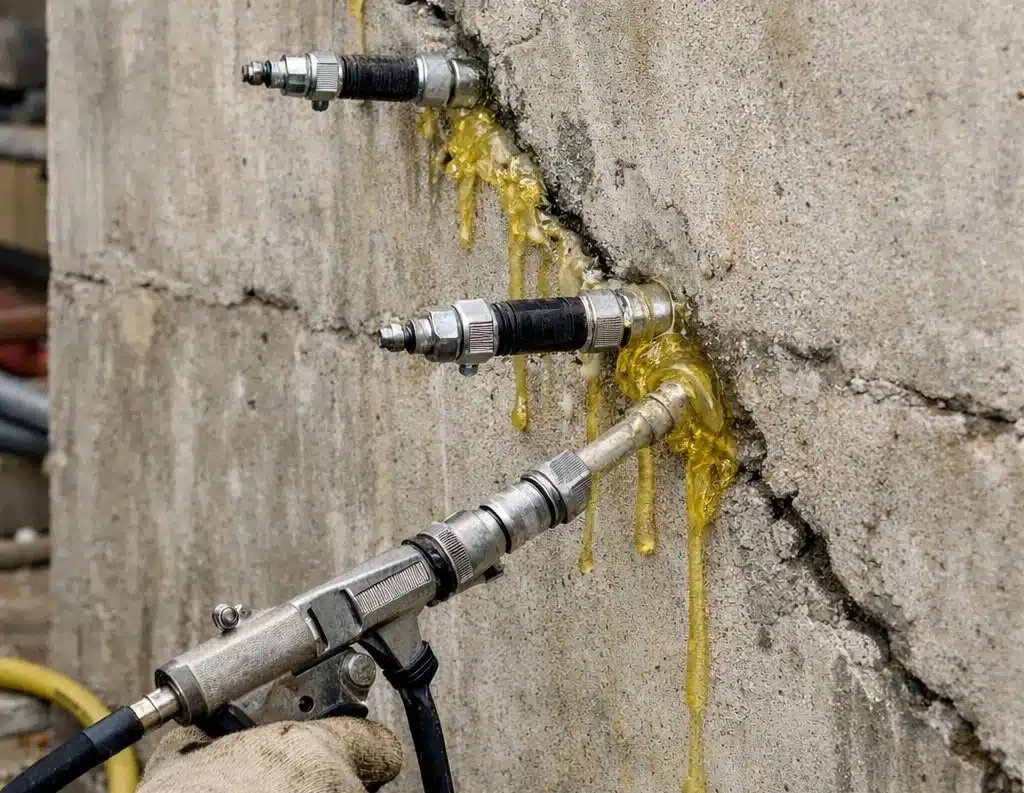
Injection grouting can be used to introduce a suitable resin into cracks, joints or voids to control water ingress. However, the resin type and injection arrangement must be selected according to the actual site condition.
OSE provides injection-grouting and underground water-sealing solutions for tunnels, shafts, pipe-jacking works and other deep-underground environments. Contact OSE to discuss a tunnel water-leakage condition or injection requirement.
Insights & Article