

Injection Grouting
How Injection Grouting Works for Underground Waterproofing
Learn how injection grouting is used to trace, fill and seal water-leakage paths in tunnels, shafts, basements and other underground concrete structures.
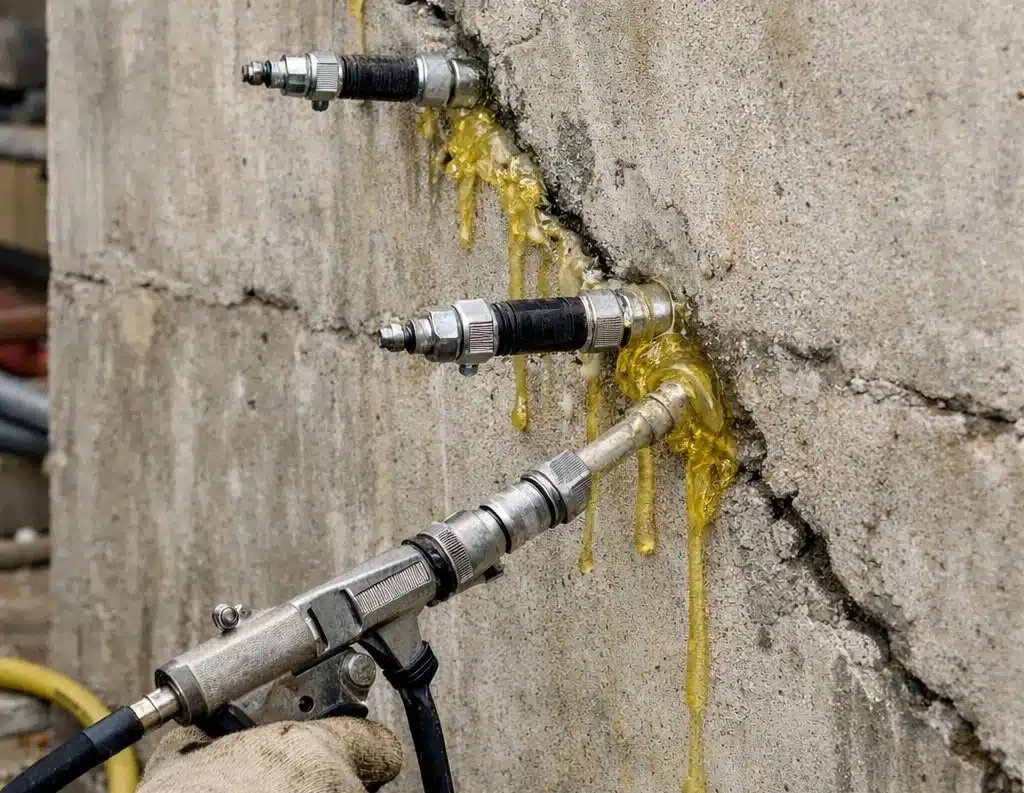
Underground structures are continuously exposed to groundwater and surrounding soil conditions. Water may enter through cracks, construction joints, segment joints, honeycombed concrete, service penetrations or other discontinuities in the structure.
Unlike surface treatments that cover only the visible area, injection grouting introduces a suitable material into the crack, joint, void or surrounding ground through which water is travelling. The injected material reacts or cures within the leakage path, forming a seal that helps control water ingress.
The effectiveness of the treatment depends on more than simply injecting resin at the point where water is visible. The leakage path must first be assessed, followed by the selection of an appropriate material, injection layout and application method.
What Is Injection Grouting?
Injection grouting is a remedial waterproofing method in which a liquid grout or resin is delivered under controlled pressure into cracks, joints, voids or porous areas.
Depending on the selected material and site condition, the grout may react with water, expand, remain flexible or cure into a more rigid material. Its purpose may include:
Sealing active water leaks
Filling cracks and construction joints
Closing voids within or behind concrete
Controlling groundwater seepage
Creating a water-resistant barrier
Stabilising selected areas of surrounding ground
Injection grouting is commonly used where the leaking area is difficult or impractical to access from the external face of an underground structure.
Applications may include tunnels, shafts, deep basements, retaining walls, pipe-jacking works, manholes and reinforced-concrete linings.
How Water Travels Through Underground Structures
The location where water appears inside a structure is not always the point where it first entered.
Groundwater may follow cracks, joints, interfaces and voids before emerging at a different location. Water can also travel behind a concrete lining or along embedded components. Treating only the visible wet surface may therefore fail to address the actual leakage route.
Before injection begins, the site team should assess:
Whether the leakage is active or dormant
The apparent entry and discharge points
Crack or joint configuration
Substrate condition
Approximate water flow and pressure
Accessibility around the affected area
Previous repair attempts
Possible voids behind the structure
This assessment helps determine where injection points should be positioned and which material properties are required.
The Injection-Grouting Process
The precise procedure varies according to the structure, leakage condition, selected material and project requirements. A typical injection-grouting operation involves the following stages.
1. Inspecting the Leakage Area
The affected surface is examined to identify visible cracks, joints, damp areas and active water discharge points.
Where necessary, the surface may be cleaned so that the leakage pattern and condition of the concrete can be assessed more clearly. The objective is to understand the probable path of water rather than treating only the most visible symptom.
2. Planning the Injection Points
Injection points are positioned to allow the grout to reach and intersect the suspected leakage path.
For concrete cracks, holes may be drilled at an angle towards the crack rather than directly into its exposed surface. Other configurations may be required for construction joints, segment joints, wall interfaces or voids behind a lining.
The spacing, angle and depth of these points must be determined according to actual site conditions. A general blog article should not be used as a substitute for a project-specific injection plan.
3. Installing Injection Packers
Injection packers are fitted into the prepared holes. These packers provide a connection between the injection pump and the area being treated.
They help introduce the material under controlled pressure while limiting its return through the drilled opening. The type and size of packer used will depend on the substrate, equipment and selected injection material.
4. Selecting the Injection Material
The correct injection material depends on the nature of the leakage and the intended outcome.
Polyurethane injection resins are commonly used to control water ingress because certain formulations react in wet conditions and can accommodate some movement after curing. However, polyurethane products do not all behave in the same way. Reaction time, expansion, viscosity, flexibility and water sensitivity differ across formulations.
Other materials, including epoxy or cement-based grouts, may be considered for different repair objectives. A material suitable for stopping an active leak may not be appropriate for restoring strength to a dry concrete crack.
Selection should therefore consider:
Active or inactive leakage
Water flow and pressure
Crack or void size
Dry or water-bearing conditions
Required flexibility after curing
Resin viscosity
Reaction and curing behaviour
Substrate and structural movement
Manufacturer requirements
Project specifications
5. Injecting the Grout
The selected material is pumped through the packers under controlled conditions. Injection may proceed progressively from one point to another so that the movement of the grout can be monitored.
During this stage, the applicator observes factors such as:
Material consumption
Resistance encountered during injection
Grout appearing at an adjacent packer
Changes in the visible water flow
Unexpected material escape
The response of the crack or joint
Excessive or uncontrolled pressure can result in unintended grout movement or damage to the substrate. Injection pressure and equipment settings must therefore be determined by trained personnel based on site conditions and the product manufacturer’s guidance.
6. Allowing the Material to React or Cure
Once introduced, the material fills the available leakage path and begins to react or cure.
For water-reactive polyurethane resin, contact with moisture can initiate a reaction that forms a foam or flexible sealing material, depending on the formulation. The resulting barrier helps restrict further water movement through the treated path.
The packers may be removed after the specified curing period, and the drilled openings are then made good using a compatible repair material.
7. Inspecting and Verifying the Treatment
The treated area should be monitored after injection. This helps determine whether the visible leakage has stopped, reduced or shifted to another path.
Additional injection may be necessary when:
Water is travelling through several connected cracks
The first injection did not fully penetrate the leakage path
Hidden voids remain behind the structure
Leakage reappears at an adjacent joint or defect
Site conditions differ from the initial assessment
Injection grouting is therefore often an investigative and controlled process rather than a single injection at one visible point.
Where Injection Grouting Is Commonly Used
Injection grouting can be applied to various underground-construction conditions, including:
Cracks in reinforced-concrete walls and slabs
Tunnel segment joints
Construction and movement joints
Leakage around pipe penetrations
Tunnel and shaft linings
Pipe-jacking reception and launch areas
Sheet-pile interlocking joints
ERSS retaining-wall leakage
Deep-basement water ingress
Voids behind concrete linings
Localised groundwater seepage through surrounding ground
The method and material must be matched to the actual defect. Not every case of underground water ingress can be resolved using the same resin or injection arrangement.
Why Injection-Grouting Results Can Vary
Unsuccessful injection work is not always caused by the injection material itself. Performance can also be affected by incomplete diagnosis, unsuitable packer positioning, poor substrate preparation, incorrect equipment selection or failure to account for the actual water route.
Common difficulties include:
Treating only the visible discharge point
Using a resin with unsuitable reaction or flexibility characteristics
Failing to identify interconnected leakage paths
Allowing the material to escape into unintended voids
Applying inappropriate injection pressure
Stopping the operation before adequate grout penetration is achieved
Ignoring movement at joints or cracks
Using equipment that cannot control material delivery properly
A successful treatment requires the leakage condition, injection material, pump, packers and application sequence to work together.
Injection Grouting as Part of an Underground Waterproofing Strategy
Injection grouting is particularly useful for remedial leakage control and locations that cannot be accessed externally. However, it should not automatically be treated as a replacement for every waterproofing membrane, joint system or groundwater-control measure.
For new construction, the wider waterproofing design may include membranes, waterstops, joint detailing, drainage and concrete-quality controls. Injection grouting can supplement these measures by treating localised defects or water paths that develop during or after construction.
The most appropriate approach depends on the structure, construction stage, groundwater condition and required service performance.
Specialist Support for Underground Leakage
OSE provides injection-grouting, water-sealing and groundwater-control solutions for tunnels, shafts, pipe-jacking works, deep basements and other underground-construction environments.
Our team also supplies injection resins, pumps, packers and related accessories for different application requirements. Each leakage condition should be assessed before determining the appropriate material and injection approach.
Contact OSE to discuss an underground leakage problem or injection-grouting requirement.
The technical process above is consistent with manufacturer guidance that begins with identifying and preparing the leaking crack or joint before drilling, installing packers and injecting under controlled conditions. Exact execution must follow the selected product’s technical data and the project-specific assessment. GCP technical guidance OSE’s published service scope includes deep-underground waterproofing, pipe-jacking leakage treatment, sheet-pile and ERSS leakage treatment, and soil grouting. OSE services
Insights & Article


